what we leave out. and why.
Oxybenzone, octinoxate, and the ingredient decisions behind SunKids™.
the short version.
What goes into a sunscreen matters. So does the thinking behind what stays out. At SunKids™, we consider each ingredient’s purpose, skin tolerance, and research into potential environmental effects. That includes oxybenzone and octinoxate, two chemical UV filters we’ve chosen not to use. Instead, we use 24.1% non-nano zinc oxide as our sole sunscreen active.
But not everything on our exclusion list is there for the same reason. Here’s a closer look.
oxybenzone. why we leave it out.
Oxybenzone is a chemical UV filter that absorbs ultraviolet radiation to help protect skin. It’s also been studied for its potential effects on marine organisms. The National Oceanic and Atmospheric Administration (NOAA) identifies oxybenzone among sunscreen ingredients that may affect aquatic life, while research continues into how those findings translate to real-world marine environments.
Skin tolerance is another consideration. Oxybenzone is a documented cause of contact and photoallergic reactions in some individuals. That doesn’t mean everyone who uses it will experience irritation. But it’s one of the factors that informed our decision to formulate without it.
octinoxate. another deliberate choice.
Octinoxate is another chemical sunscreen filter, primarily used to absorb UVB radiation. Like oxybenzone, it’s been investigated for potential effects on aquatic organisms. NOAA includes octinoxate among sunscreen ingredients of environmental concern. But the effects observed in research depend on factors such as concentration, exposure, and the organisms being studied.
It’s important not to confuse a potential environmental hazard with proof that every sunscreen containing an ingredient causes environmental damage.
Hawaii’s Act 104 restricts the sale and distribution of sunscreens containing oxybenzone or octinoxate without a prescription, subject to the law’s exceptions.
SunKids™ is formulated without both ingredients. It’s a specific choice that aligns with our formulation approach, not a claim that our sunscreen has no environmental impact.
why we chose mineral protection.
Rather than combining several chemical UV filters, we chose to formulate SunKids™ with one mineral sunscreen active. 24.1% non-nano zinc oxide. Zinc oxide provides protection across the UVA and UVB spectrum. Our finished sunscreen is labeled Broad Spectrum SPF 50 and Water Resistant (40 Minutes). But the amount of zinc oxide alone doesn’t determine SPF.
Particle characteristics, dispersion, film formation, and the complete formulation all affect how a sunscreen performs. That’s why finished-product testing matters. We chose non-nano zinc oxide because it aligned with the type of mineral sunscreen we wanted to create. Not because every chemical sunscreen is unsafe. You can learn more about that decision in why we chose non-nano zinc oxide.
the rest of the list has its own reasons.
Oxybenzone and octinoxate aren’t the only UV filters we leave out. SunKids™ is also formulated without avobenzone, octocrylene, homosalate, and octisalate. Our decision to use zinc oxide as our sole sunscreen active means these additional chemical UV filters aren’t part of our formula. Research into skin allergies, systemic exposure, and potential environmental effects provides additional context for evaluating individual sunscreen ingredients.
But those findings aren’t identical for every UV filter. And we don’t believe they should be presented as though they are. Different ingredients deserve individual consideration.
let’s talk preservatives.
Preservatives don’t always get much attention, but they play an important role in skincare. They help protect products from microbial contamination during storage and use. And that’s especially important for products that contain water. We chose a preservation system formulated without parabens, phenoxyethanol, formaldehyde-releasing preservatives, methylchloroisothiazolinone, and methylisothiazolinone.
But the reasons behind these exclusions differ. For parabens and phenoxyethanol, our decisions reflect formulation preferences rather than a claim that these preservatives are universally unsafe. For formaldehyde-releasing preservatives and certain isothiazolinones, documented contact-allergy concerns are additional considerations.
The FDA identifies several preservatives among ingredients associated with cosmetic allergies.
Still, leaving a particular preservative out doesn’t automatically make a product safer. The finished formula must have an appropriate preservation system and be evaluated for microbiological quality. That’s something we take seriously.
and the choices you can see.
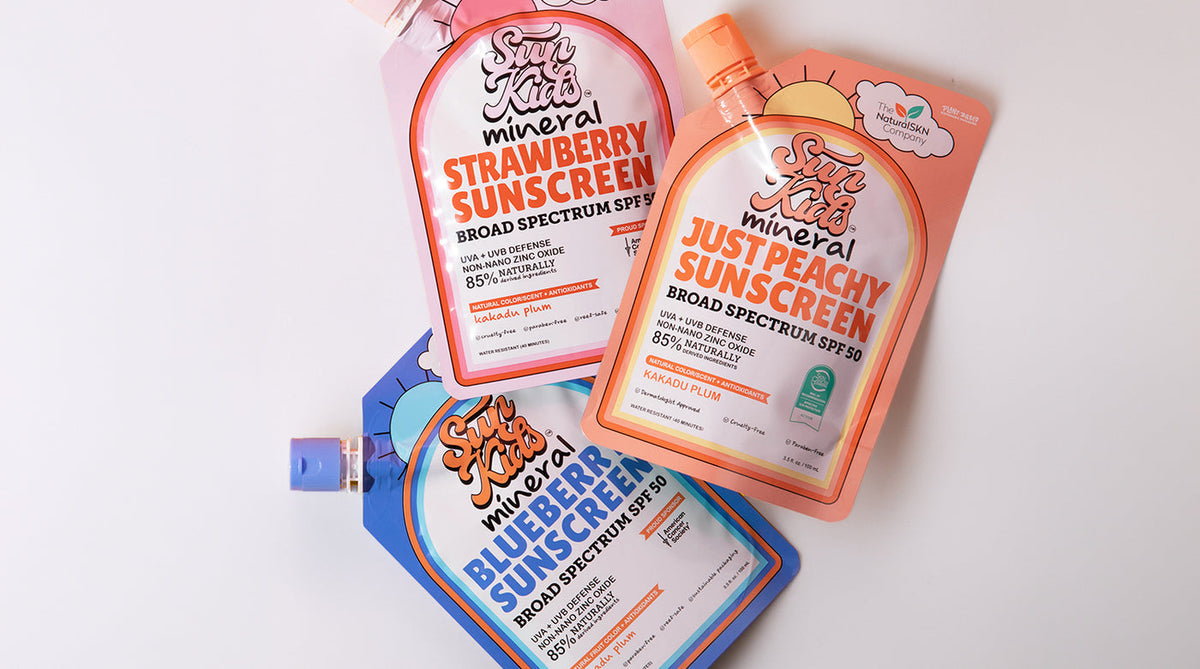
Not every ingredient decision is about UV filters or preservatives. Some are about the experience of using sunscreen. We use color sourced from plants, without artificial dyes. Our Blueberry formula has a blue tint, while Strawberry goes on with a soft pink color. Both are designed to blend into skin without leaving a visible tint.
We also chose a squeezable pouch rather than an aerosol format that uses propellants such as butane or isobutane. These are different types of formulation and packaging decisions. They don’t all carry the same safety or environmental implications. But they reflect how we wanted SunKids™ to look, feel, and function. You can explore our full ingredient exclusions in NOT IN MY SUNSCREEN.
what we put in matters, too.
A sunscreen shouldn’t be defined only by what it doesn’t contain. The ingredients we include matter just as much. SunKids™ is a 100% mineral sunscreen powered by 24.1% non-nano zinc oxide, alongside ingredients selected for their roles in the complete formula. Glycerin helps attract moisture. Squalane helps soften skin and reduce moisture loss.
Vitamin E contributes antioxidant and skin-conditioning properties. Kakadu plum extract is another botanical ingredient featured in our formulas. And while these ingredients contribute different properties, it’s important to remember that the presence of an ingredient doesn’t automatically establish a specific clinical benefit for the finished product.
That’s why we consider formulation and testing alongside ingredient selection. Our Blueberry mineral sunscreen and Strawberry mineral sunscreen bring those choices together in two fruit-inspired formulas designed for everyday sun protection.
thoughtful choices. clear explanations.
We believe ingredient transparency should make skincare easier to understand. Not more confusing. Some of our exclusions reflect skin-tolerance considerations. Others involve environmental research. And some are simply formulation preferences. Those distinctions matter. Because the science behind an ingredient depends on how it’s used, its concentration, and the conditions under which it’s studied.
We don’t believe every ingredient we leave out is inherently harmful. And we don’t believe a long exclusion list automatically makes a product better. What matters is the thinking behind the formula. What we leave out is intentional. What we put in has a purpose.
a little more to explore.
Curious about the ingredients, testing, and research behind SunKids™?
This article is for general educational purposes and isn’t a substitute for personalized advice from a pediatrician or board-certified dermatologist who understands your family’s skin and health history.
Learn more at theNaturalSKNcompany.com